Click Testing My Way to Better Book Ads
It's been a little longer than usual since my last Practical Indie Author article.
There's a reason for that.
I've been experimenting.
A quick warning before we get into this: this article does not contain the magic formula for winning at Facebook or BookBub ads.
I haven't found one. I'm increasingly suspicious that nobody has.
What I have learned is how to look much more closely at what my advertising is actually doing. Which numbers matter? What do they tell me? When does a cheap click actually have value? Which ad gets credit when a reader clicks through to Amazon or comes back through a retargeting ad three days later?
Click testing hasn't given me all the answers. In fact, quite often it's given me more questions.
But it has helped me make much more deliberate decisions about where I spend my advertising money. And while I've been running these experiments, something rather exciting has happened with my book revenue too.
I can't tell you that click testing alone caused it. It didn't.
But I can show you what I tested, what I learned, where I completely muddied my own results, and what I'm changing next.
Hopefully, somewhere in my mess, you'll find something useful for your own experiments.
So What Have I Been Testing?
Over the past few weeks, I've been running what has occasionally become a slightly obsessive series of tests on my Facebook and BookBub ads.
Hooks. Images. Copy. Headlines. Authors. Countries. Bids.
I've changed one thing, watched what happened, picked a winner, and moved on to the next.
Well, that was the plan anyway.
Somewhere along the way, my beautifully organised experiment became slightly less beautifully organised. I started keeping too many options, changing more than one thing at a time, and occasionally having absolutely no idea which change had actually produced the result I was seeing.
But I learned a lot.
And somewhere in the middle of all this testing, something else happened.
At the beginning of the year, I'd set myself two fairly ambitious revenue goals for my author business.
$100 a day by September.
$150 a day by December.
This month, I crossed that first hurdle early.
Now, I'm not going to tell you that click testing magically caused every one of those sales. It didn't. There are far too many moving pieces in my author business for me to make that claim.
I have multiple books with read-through. I sell direct from my website. I'm building my mailing list. I advertise through BookBub and Facebook. I run promotions. And occasionally, lovely readers simply find my books all by themselves.
But becoming much more deliberate about how I test my advertising has changed the way I spend my marketing money.
And, perhaps more importantly, it has helped me stop guessing.
It Started With One Simple Rule
My original testing plan was beautifully simple.
I would test:
Hook → Image → Body Copy → Headline
One thing at a time.
I'd start with the hook because if the first line didn't make someone stop scrolling, it didn't really matter how brilliant the rest of my ad was.
So I created several versions.
Some worked.
Some really didn't.
Eventually, one started consistently performing well:
"Murder, knitting, and a mischievous Westie..."
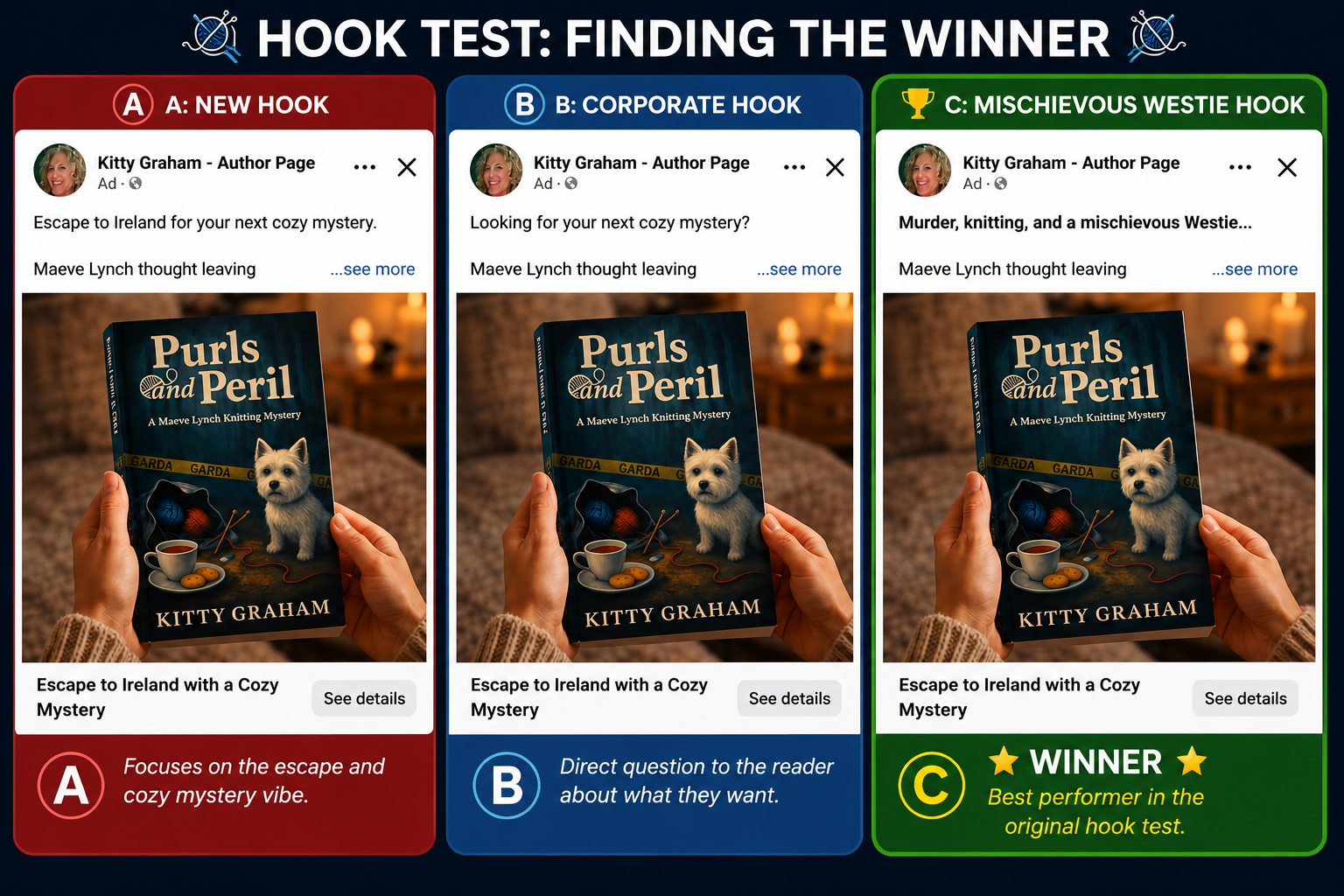
Once I had a hook that appeared to be working, I stopped changing it.
Or at least I was supposed to.
Because now I wanted to know what happened if I changed the image.
Then I Changed the Image
I had an older image I'd been using for some time, showing my book in a reader's hand.
I also had newer creative leaning much more heavily into the knitting and cozy elements of the series and an older image of a flat lay with a cup of coffee.
So I tested them.
Same hook. Different image.
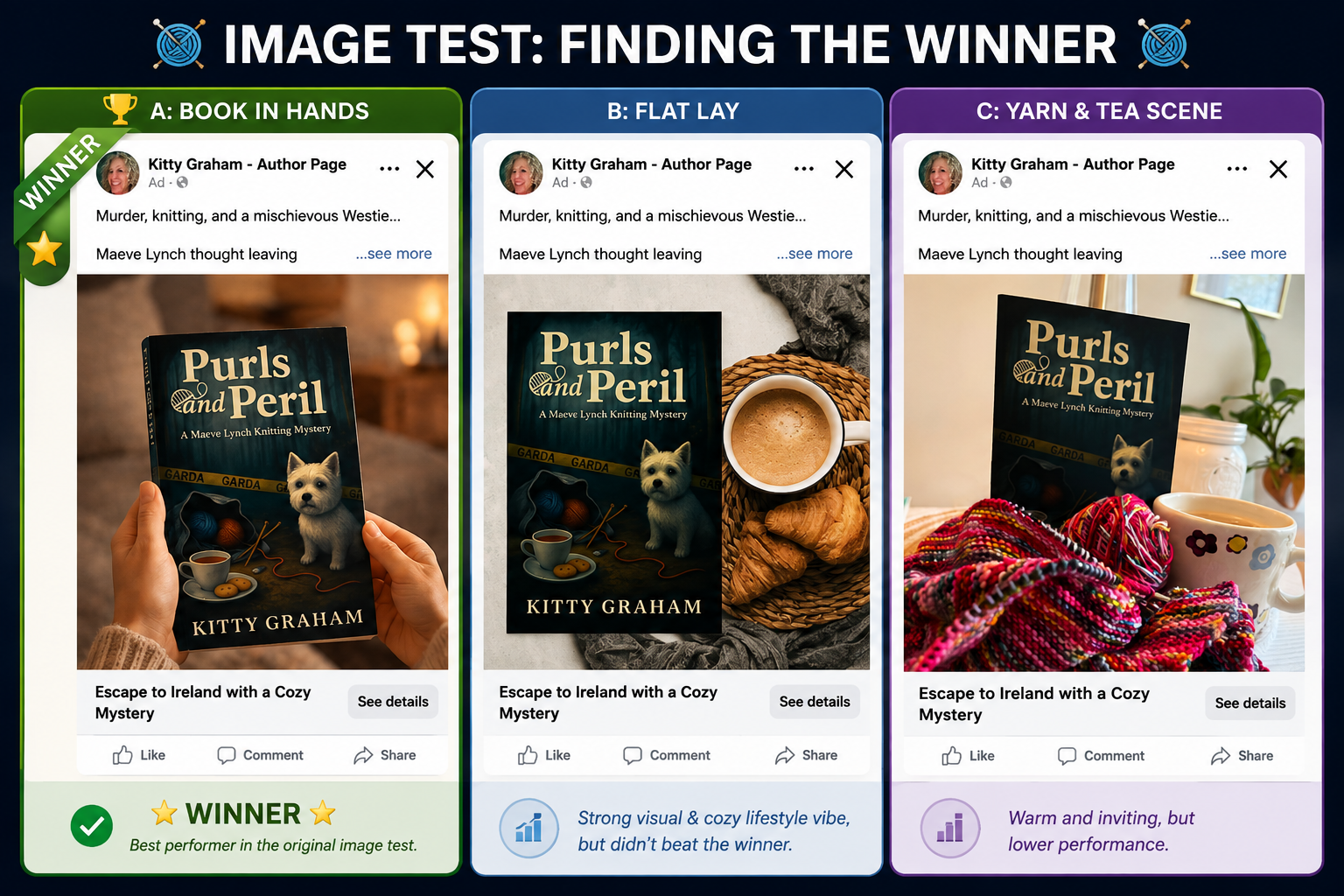
That's where things got interesting.
The book-in-hands image came out on top overall.
But when I started looking more closely at the results, things became more interesting.
Some combinations seemed to perform better in the UK and Ireland. Others did better in the US. Australia and New Zealand could start incredibly strongly and then slow down.
That was my first reminder that there probably isn't such a thing as the perfect Facebook ad.
There may only be the right ad for the right reader.
Then Came the Words
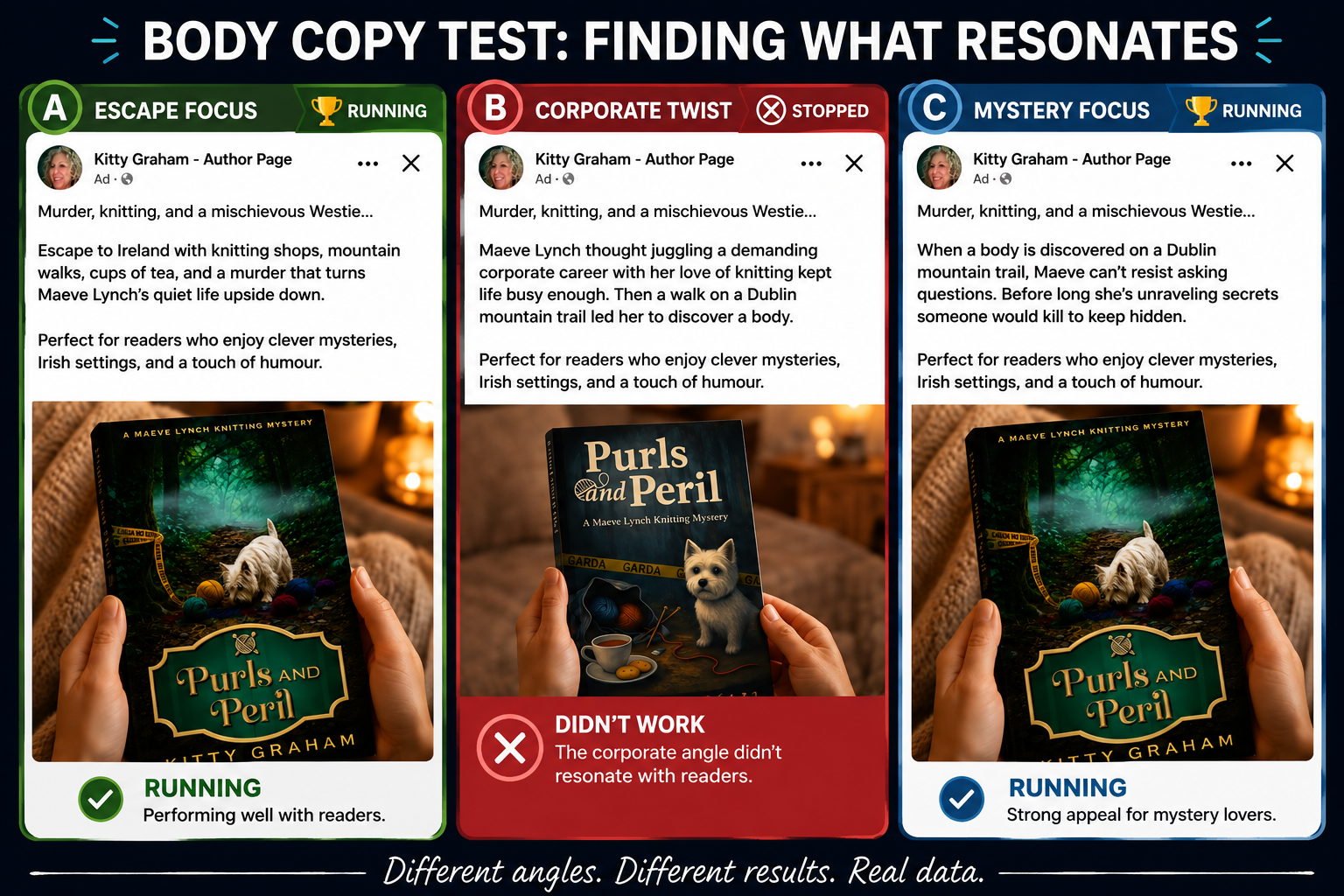
Once I had stronger images, I started experimenting with the body copy.
Again, the idea was to keep everything else the same and change only the words.
As a writer, I would love to tell you that this was obviously the most important part.
Facebook had other ideas.
The corporate angle I'd thought might distinguish Maeve from other cozy sleuths didn't particularly resonate. Meanwhile, both the escape-focused and mystery-focused versions gave me enough reason to keep testing them.
So I stopped asking which version I liked better and started watching what readers actually did.
This sounds incredibly obvious when I write it down.
But there is a big difference between saying, "I'll let the data decide," and actually turning off the beautifully written ad you love because nobody is clicking on it.
And Then I Broke My Own Rules
This is probably the most useful thing I learned from the whole experiment.
Testing one thing at a time works really well.
Actually doing it is much harder.
I was tracking direct sales on my website, and because my Facebook ads were sending readers directly to my book page, Facebook could tell me which ads were generating those sales.
Great.
Except my book page also has buttons taking readers to Amazon and other retailers.
And while my direct sales were growing, so were my Amazon sales.
That raised a fairly obvious question.
Were some of the people clicking my Facebook ads landing on my website, deciding they'd rather buy from Amazon, and clicking straight through?
Using Google Analytics, I started tracking those outbound clicks too.
And that's when things got complicated.
One ad might be generating the most direct sales.
Another might be sending far more people to Amazon.
Another might be getting clicks through to Audible.
So which ad was actually winning?
Facebook's A/B testing wasn't particularly helpful here. I could track multiple actions, but when one ad won on direct sales and another won on Amazon clicks, there wasn't necessarily a clear overall winner.
Before long, I had three ads that all kind of worked.
And because they all kind of worked, I didn't want to turn any of them off.
Then I remembered my retargeting ad.
This ad was aimed specifically at people who had already visited my website but hadn't bought anything during that visit.
And it was doing great business while I was running my click tests.
Wonderful.
Except...
Which of my original ads had brought those people to my website in the first place?

If Ad A introduced someone to my books, they browsed around and left, and my retargeting ad brought them back three days later to buy, which ad deserved the credit?
Ad A?
The retargeting ad?
Both?
At this point, my head was exploding.
I'd started with a beautifully simple experiment:
Hook → Image → Copy → Headline
Now I was looking at direct sales, Amazon clicks, Audible clicks, retargeting sales and different attribution paths, while simultaneously trying to decide which creative was actually responsible for bringing the right readers into my world.
I felt like I was experimenting randomly again.
So I had to become stricter.
If I was testing the image, I needed to test the image.
If I was testing the hook, I needed to test the hook.
And if something lost, I needed to be willing to let it lose.
Testing only works if you're prepared to eliminate things.
That was harder than I expected.
Not All Readers Behave the Same Way
The next part of the experiment tied into something I'd already discovered while building my audience beyond Amazon.
Readers in different countries don't necessarily behave in the same way.
I'd already learned that small things matter. "Cozy" in the US becomes "cosy" elsewhere, for example.
But now I was seeing differences in the advertising data too.
The US, UK, Ireland, Canada, Australia, New Zealand and South Africa didn't always respond to the same ads in the same way.
An image that attracted attention in one country might be mediocre somewhere else.
A hook could perform brilliantly in one market and struggle in another.
And, perhaps most importantly, the readers didn't necessarily buy in the same places.
Some markets were stronger for Amazon. Others were more interesting for Kobo. New Zealand had already surprised me with the number of readers willing to buy directly from my website.
So I stopped thinking of my audience as one enormous group of English-speaking cozy mystery readers.
I started separating the markets and asking much more specific questions.
What happens if I show this image to Australian readers?
Does this hook perform as well in the UK?
Are Canadian readers clicking through to a retailer rather than buying directly?
Is the ad actually failing, or is that particular audience simply buying somewhere I'm not measuring properly?
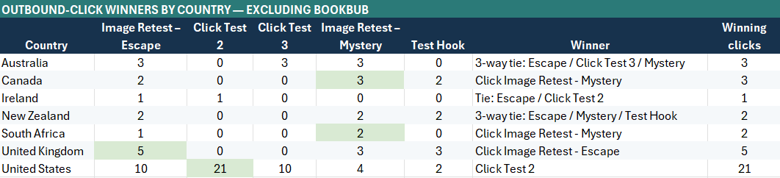
Smaller international samples are directional rather than definitive
I don't have all the answers yet.
That's why I'm still testing.
But I have stopped assuming that an ad that works in one market will automatically work everywhere else.
And Then There Was BookBub
While all of this was happening on Facebook, I was also experimenting with BookBub ads.
But I didn't simply copy my winning Facebook ad across.
I already had BookBub ads running with copy I'd used before, so I decided to change just one thing. I took the image that was performing well on Facebook and swapped it into my existing BookBub ads.
I also decided to do something differently from my previous BookBub campaigns and keep Amazon in my retailer targeting this time. I was curious to see what would happen.
And, because I sell books directly, I included my own website alongside the retailer links.
Then the data started coming in.
And once again, what looked good depended entirely on which number I was looking at.
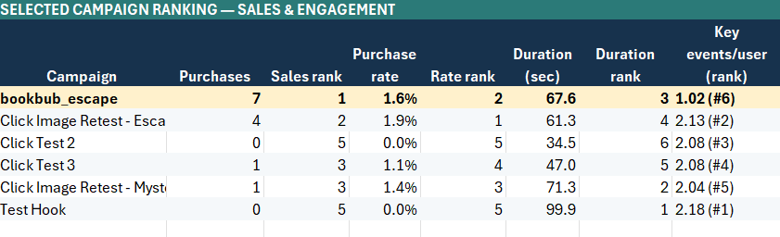
One of my Facebook hook tests produced an average engagement time of almost 100 seconds and the highest number of key events per visitor of any of the campaigns I compared.
It produced no direct sales.
Another Facebook image test kept visitors engaged for more than 71 seconds.
It produced one sale.
Meanwhile, my BookBub campaign wasn't producing my most engaged visitors. Average engagement was around 68 seconds.
But it produced seven direct purchases, more than any of the other campaigns I was comparing.
Even that didn't give me a simple winner.
One of my Facebook image retests generated four purchases from fewer visitors, giving it a slightly higher purchase rate of 1.9%, compared with 1.6% for the BookBub campaign.
So which was better?
The Facebook campaign with the higher conversion rate?
Or BookBub, which generated the most actual sales?
Welcome back to my exploding head.
Engagement Wasn't the Same as Buying Intent
This was probably one of the more useful discoveries from the experiment.
I'd been looking at engagement as an indication that I was attracting the right people.
And it is useful.
Someone spending a minute or more exploring my website is certainly more interesting to me than someone who arrives and disappears ten seconds later.
But my data was making something very clear:
The visitor who stays longest isn't necessarily the visitor who buys.
My almost-100-second Facebook visitors hadn't bought anything directly during this test.
My BookBub visitors spent less time on the site, but they were buying.
That made me start thinking less about whether I was attracting "engaged traffic" and more about intent.
Someone clicking a BookBub ad is already on a platform dedicated to discovering books. They don't necessarily need to spend two minutes figuring out whether they're interested in buying one.
They may arrive with a very different purpose.
I can't prove that's what caused the difference from this data alone, but it gave me another question worth testing.
And, of course, the direct purchases were only part of the picture.
My website also has buttons sending readers to Amazon and other retailers.
So I now needed to consider:
How many people bought directly?
How many clicked through to Amazon?
Were my Amazon sales moving alongside the campaign?
What was happening on the other retailers included in my BookBub ads?
And what happened when someone visited my website, left, saw my retargeting ad later and came back to buy?
Once again, attribution was getting messy.
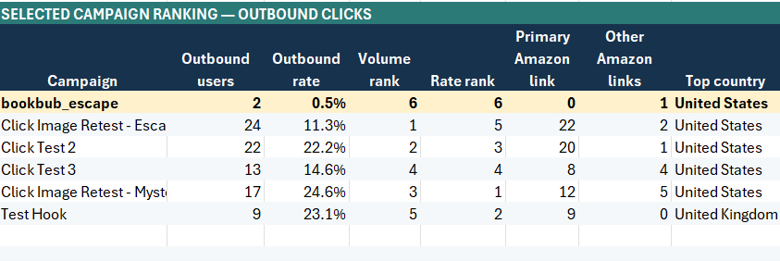
Outbound clicks from my book 1 landing page to Amazon and other retailers
Then I Looked at Where BookBub Was Spending My Money
There was another thing bothering me.
My direct website link was consuming a large proportion of my BookBub advertising budget.
And now I had good evidence that BookBub was sending valuable traffic. The campaign had generated more direct purchases than any of the individual campaigns I'd compared.
But I still didn't want all of my advertising budget flowing toward my own website.
Part of the reason I advertise on BookBub is to reach readers where they prefer to buy.
I wanted Kobo readers.
Apple Books readers.
Barnes & Noble readers.
Amazon readers.
And direct readers.
If BookBub was finding inexpensive clicks to my website and consequently spending most of my budget there, I needed to know what would happen if I changed the economics.
So that's the experiment I'm running now.
I'm adjusting the CPC I'm willing to pay for my direct link.
Not because I want to stop sending people to my website.
And certainly not because those clicks aren't producing sales.
I'm doing it because I want to see whether reducing what I'm willing to pay for direct traffic allows more of my BookBub budget to reach readers on the other retailers.
Will I lose some direct sales?
Will wide sales increase?
Will Amazon get more traffic?
Will total revenue improve, fall, or stay roughly the same?
I don't know yet.
That's the next test.
And I've realised that's really what this entire experiment has become.
I'm not trying to find the ad with the highest click-through rate.
I'm not trying to find the campaign with the longest engagement time.
I'm not even necessarily trying to find the cheapest click.
I'm trying to understand which readers my advertising is bringing me, what they do when they arrive, and where I want my next advertising dollar to go.
Did It Work?
That's always the question, isn't it?
My answer right now is:
I think so.
Over the past few months, I've gradually grown my book revenue, and this month I've started reaching and exceeding the $100-a-day target I'd originally set for September.
I'm thrilled about that.
But I'm also very cautious about drawing a straight line between my advertising experiments and that number.
My author business is an ecosystem.
Advertising brings in readers. Some buy directly. Some click through to Amazon or another retailer. Some join my mailing list. Some read through the series. Some come back weeks later. Some see a retargeting ad. Some tell a friend.
There isn't one Facebook or BookBub ad sitting somewhere that magically produces my daily revenue.
What I can say is that I'm spending my advertising money much more deliberately than I was before.
I know more about which images attract attention.
I know more about which hooks make people stop.
I'm learning which audiences respond to my books.
I'm seeing just how differently individual countries can behave.
And I'm getting much better at looking beyond the obvious numbers. The cheapest click isn't necessarily the best click. The longest website visit doesn't necessarily result in a purchase. And the campaign with the highest conversion rate isn't necessarily the one producing the most sales.
Most importantly, I've stopped expecting myself to create the perfect ad.
I'm trying to create a better experiment.
What Have I Learned?
If I had to reduce the last few weeks to a handful of lessons, they'd be these:
Change one thing at a time.
Otherwise you won't know what actually worked.
Decide what winning means.
Is it clicks? Direct purchases? Outbound retailer traffic? Revenue? If two ads win on different measures, you need to know which outcome matters most to you.
Let losers lose.
Keeping every "maybe" alive makes it almost impossible to learn anything.
Know what you're measuring.
A direct sale, an Amazon click, an Audible click and a later retargeting sale may all have started with the same ad. Attribution gets messy very quickly.
Don't assume your audience is the same everywhere.
The ad that wins in the US may not be the one that works in Canada, Australia or the UK.
Don't mistake a good metric for a good result.
A cheap click, a long website visit or a high conversion rate can all look impressive. None of them tells the whole story on its own.
And don't expect to finish testing.
I'm certainly not finished.
I've answered some of the questions I started with. I've created quite a few new ones. And, of course, I'm already testing the next thing.
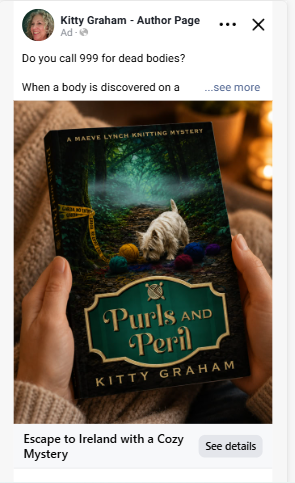
And, by the way, I started testing another new hook a few days ago.
Apparently I'm breaking my own rules all over again.
Will it work?
I have absolutely no idea yet.
Ask me in a few weeks.
That's rather the point.
I'd love to hear from you.
Did you find this helpful, interesting, confusing, or did it leave you with even more questions? Are you testing your own ads and seeing something completely different?
Let me know. I genuinely love hearing what other indie authors are trying, and your questions might even inspire my next experiment.
