My Ads Said 1.5x. My Bank Said Otherwise
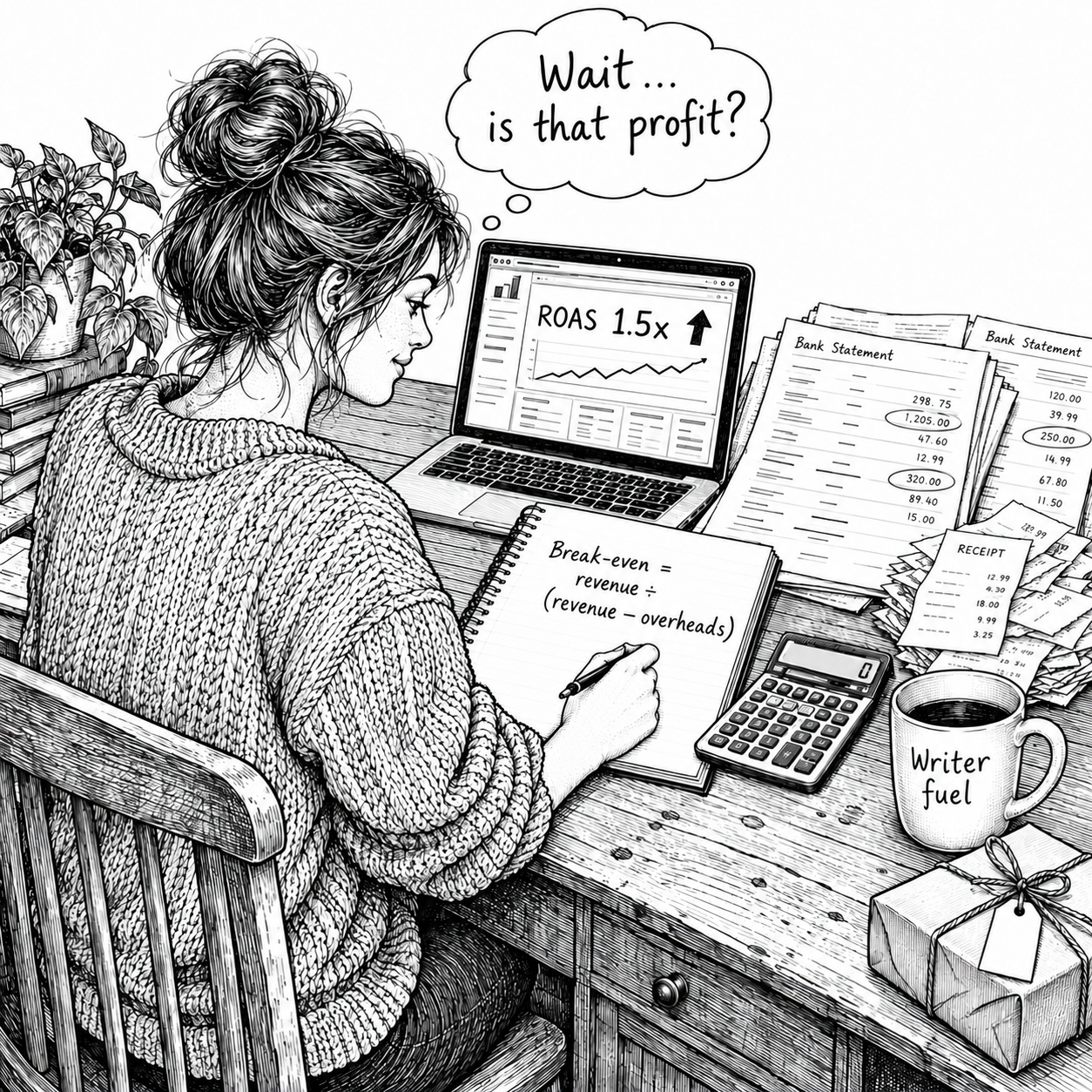
In my last Practical Indie Author article on my click-testing experience, I told you I'd hit $100 a day in book revenue a month early.
That was true.
What I didn't know was whether I was actually making any money or what my real break-even was.
My tracker said my ads were returning about 1.5x. For every dollar I spent, about a dollar fifty came back. That felt good. That felt like a business.
Then I did something I'd been quietly avoiding for months.
I put every statement side by side. My author bank account. My credit card. My personal account. My retailer reports. All of it.
And I asked one very simple, very uncomfortable question.
If I add up everything that came in, and everything that went out, what's left?
What I Was Actually Measuring
Like a lot of indie authors, I'd been tracking one number very carefully.
Revenue divided by ad spend.
It's a useful number. It tells you whether your ads are pulling their weight.
But it only counts two things. The money from book sales and the money spent on ads.
It doesn't count your website. Your email platform. Your design tools. Your editor. Your cover designer. The conference you went to. The bookmarks for the book fair.
I knew all of those things cost money, obviously.
I just hadn't put them in the same sum.
Leak One: The Ad Spend I Wasn't Logging
This was the first surprise.
When I compared what Facebook had actually charged me with what I'd typed into my tracker, the bank was higher.
About $800 higher over six months.
Some of it was timing. Some of it was charges I'd simply missed. Either way, my ROI looked better than it really was, because I was dividing by a smaller number than I'd actually spent.
If you track your ads by hand, check your platform's billing page against your tracker. Not the dashboard. The billing page.
Leak Two: Costs Living on the Wrong Card
This one is a bit embarrassing.
When I started publishing, I paid for things with whatever card was handy. A tool here. A subscription there. Amazon Ads on my personal credit card because that's what was set up first.
So when I looked at my author account, it looked better than my business really was.
When I pulled everything together, I found:
business subscriptions scattered across three different accounts
the same design tool being charged on two of them
a monthly subscription I genuinely couldn't identify until I'd gone digging
editing and services paid personally that never made it into my business numbers
None of it was dramatic on its own.
Together, my subscriptions and services came to about $14 a day.
That's before a single ad runs.
Leak Three: The Money I'd Forgotten I Was Earning
Not every surprise was bad.
My tracker records audiobooks sold through my own website. It didn't record my royalties from Audible and other audio retailers at all.
That was about $7 a day I wasn't counting.
So my real revenue was higher than I thought. Small win. I'll take it.
The Sum I Should Have Done Months Ago
Once I had everything in one place, the maths was simple.
To break even, your ads need to cover your overheads as well as themselves.
So your break-even return isn't 1x. It's:
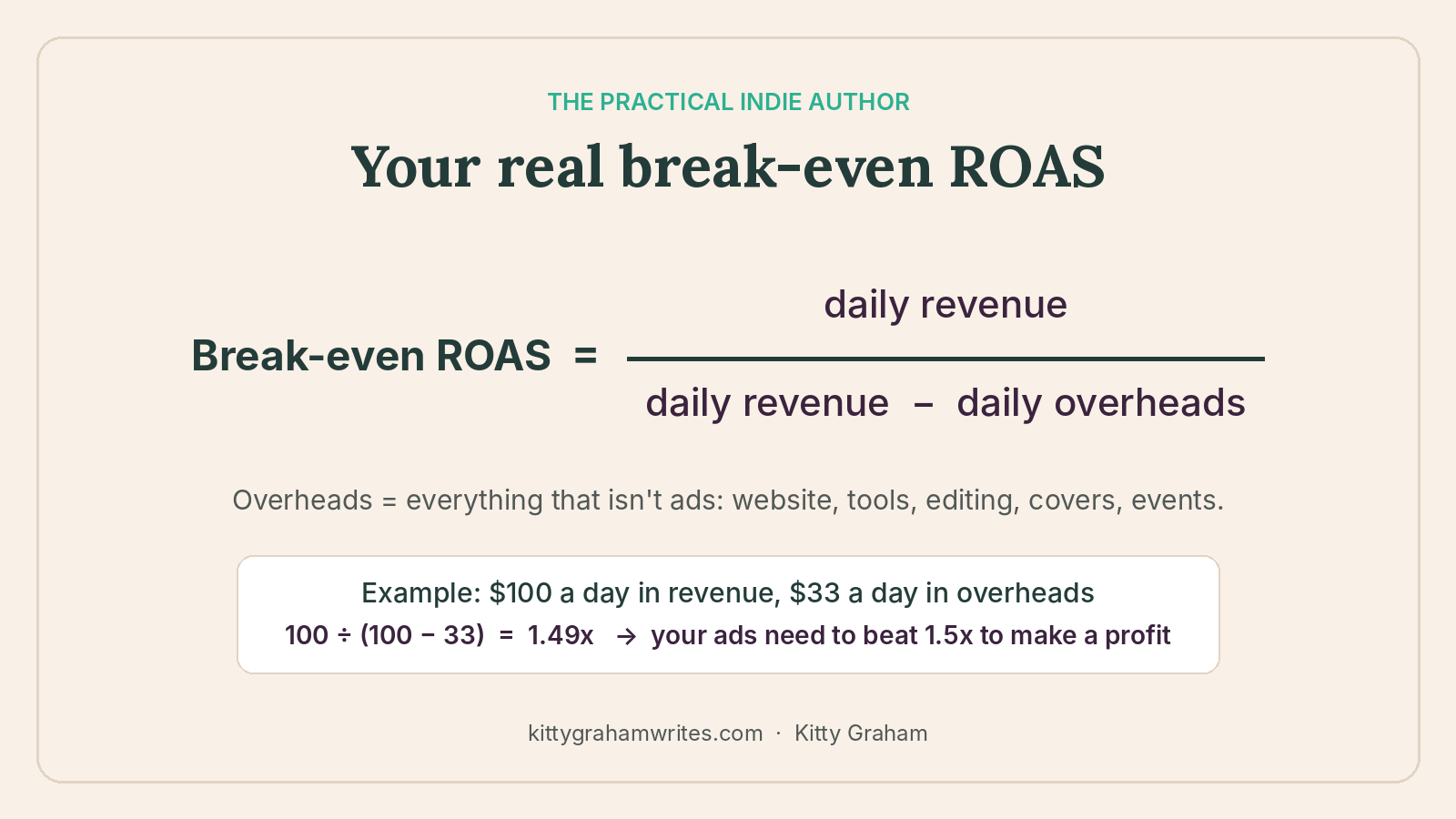
The more your fixed costs eat into your revenue, the harder your ads have to work.
For me, it came out like this:
to cover my running costs (subscriptions, website, tools): about 1.2x
to also pay for producing new books (editing, covers): about 1.5x
And my real return, once I'd added the missing ad spend and the missing audio royalties?
About 1.4x.
So my business was paying its running costs.
It wasn't yet paying for the next book.
That 1.5x I'd been so pleased about wasn't my goal at all. It was my break-even line.
Why My Bank Looked Even Worse
One more twist.
When I looked only at my bank account, things looked worse again.
That's because Amazon pays about two months in arrears. And I'd just bought stock for holiday bundles, which counts as money out now for sales that haven't happened yet.
So the bank shows cash. The tracker shows what I've earned.
Both are true. They're just answering different questions. The trick is not to mix them in the same sum, which, of course, is exactly what I did first.
What I'm Changing
A new target. My ads now need to clear 1.7x, not 1.5x. Anything below 1.5x is losing money once I count everything.
One account for everything. Every business cost is moving to my author account. No more mystery charges on the personal card.
A monthly subscription check. Duplicates, price rises, tools I haven't opened in two months. Cancel or keep, on purpose.
Audio in the numbers. My audio royalties now go into my revenue every month.
Growing revenue helps more than I realised. My overheads stay roughly the same whether I make $100 a day or $150. At $150 a day, my break-even drops to around 1.3x. Growth makes every ad dollar easier.
How to Do This Yourself
You don't need a fancy spreadsheet. You need about an afternoon.
Download six months of statements from every account that's ever paid for anything book-related.
Pull out every business cost. Ignore the personal stuff.
Sort them into buckets: ads, running costs, book production, one-offs.
Check your ad billing pages against what you've been tracking.
Add up your revenue from every source, including the ones you forget about. Audio. Direct sales. That little Google Play payment.
Do the sum. Daily revenue divided by (daily revenue minus daily overheads).
That's your real break-even.
It might be a relief. It might be a shock.
Mine was a bit of both.
But I'd much rather know.
Want to skip the maths? Download my free Break-Even Calculator.
(Already on my Practical Indie Author list? The download link is in this week’s email.)
If you try this, I’d love to hear what you find. Leave a comment below, or email me, and tell me your biggest surprise. Mine was the duplicate design tool. And the subscription I couldn't identify. Okay, mine was most of it.
